
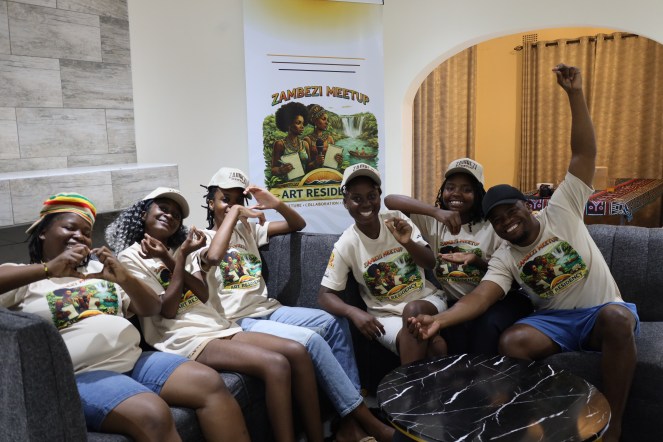
One of the main outcomes of our art projects as YIT has been realizing that storytelling is one of the easiest ways of learning and unlearning cultural practices. Across communities divided by borders, language, politics, gender, and history, one thing has consistently remained capable of reconnecting people: storytelling. Long before formal institutions of peacebuilding and diplomacy existed, communities gathered around fires, rivers, songs, poetry, and oral histories to make sense of the world and each other. Stories became the first social contracts teaching values, preserving memory, explaining pain, and imagining futures together. In contemporary society, particularly within African contexts shaped by colonial fragmentation, economic instability, migration, and social inequalities, storytelling continues to play an important role in rebuilding cohesion. Not simply as entertainment, but as a social practice capable of creating belonging, empathy, and collective understanding.
One of the most overlooked realities about social fragmentation is that communities rarely break apart because people stop living next to each other. They break apart because people stop understanding each other. The absence of shared narratives creates fear, stereotypes, isolation, and suspicion. In this sense, storytelling becomes a mechanism through which communities can renegotiate how they see themselves and each other. Creative expression, particularly poetry and spoken word, has emerged as one of the most powerful forms of contemporary storytelling because it combines emotion, performance, memory, and lived experience. Unlike formal policy discussions or institutional dialogue, poetry allows people to speak from deeply personal spaces while still touching collective realities. A poem about grief can become a communal reflection on loss. A spoken-word performance about identity can help others articulate feelings they have never had language for. Through this process, individual experiences begin to transform into shared understanding.
Social cohesion is often discussed in terms of governance, economics, or political stability, but at its core it is about relationships. It is about whether communities feel connected enough to trust one another, imagine collective futures, and recognize each other’s humanity despite differences. Cohesion cannot be legislated into existence without emotional and cultural connection. It must also be felt. When young people from different backgrounds exchange stories, they begin to discover similarities beneath assumed differences. Cultural exchange reveals that communities separated by borders often share common fears, aspirations, traditions, and struggles. Stories about womanhood, migration, love, language, or family begin to resonate across geographical divides. In this way, storytelling disrupts the “othering” that fragmentation depends on.
Much of social division is sustained by dominant narratives that normalize violence, exclusion, patriarchy, tribalism, or inequality. Communities absorb stories every day about who belongs, whose voices matter, and what forms of identity are acceptable. Creative storytelling challenges these inherited narratives by introducing new ways of seeing society. This is particularly significant in conversations around gender-based violence (GBV). Traditional prevention approaches often focus solely on awareness messaging or legal frameworks, which are important but sometimes disconnected from emotional and cultural realities. Storytelling, however, intervenes at the level of imagination and empathy. Through poetry, film, spoken word, and literature, artists are able to humanize experiences that statistics alone cannot communicate. When young women tell stories about fear, resilience, healing, autonomy, or survival, they are not only documenting lived realities, they are reshaping public consciousness. They are creating narratives that challenge silence, normalize vulnerability, and imagine relationships built on dignity and care rather than violence and domination.
In many African communities, oral traditions historically played a central role in conflict resolution and community cohesion. Elders used stories, proverbs, songs, and communal dialogue to restore harmony and teach social responsibility. Contemporary creative spaces are, in many ways, reviving these traditions in modern forms. Spoken word stages, poetry residencies, theatre spaces, documentaries, and digital storytelling platforms are becoming new communal fires around which societies gather to reflect on themselves. What makes artistic storytelling particularly powerful is its ability to hold complexity. Unlike polarized public discourse that often reduces people into categories and positions, stories allow contradiction, vulnerability, and nuance. They allow communities to sit with difficult emotions without immediately turning to defensiveness or division. This creates conditions for empathy, which is essential for cohesion.
The rise of youth-led creative movements across Southern Africa demonstrates a growing recognition that social transformation is not only political or economic, it is also cultural. Young creatives are increasingly using storytelling to address identity, mental health, migration, climate anxiety, feminism, and belonging. In doing so, they are building communities not through uniformity, but through shared humanity. Perhaps this is the most important contribution storytelling makes to cohesion: it reminds people that they are not alone. A person listening to a poem may discover that someone else has experienced the same grief. A cross-border collaboration may reveal shared cultural memory between communities divided by colonial boundaries. A documentary may allow audiences to see young women not as statistics or victims, but as thinkers, creators, and leaders shaping their own narratives.
These moments may appear small, but they accumulate into something powerful: trust, recognition, solidarity, and collective imagination. In societies increasingly marked by polarization, loneliness, and fragmentation, storytelling offers something profoundly necessary the ability to see ourselves in one another again.


